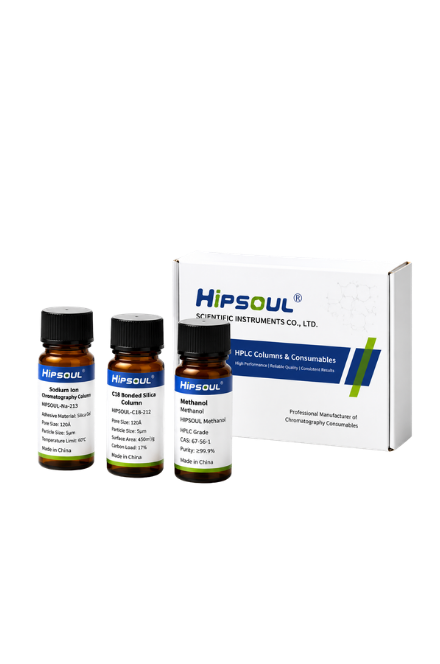
Clean Samples. Reliable Results. Every Analytical Method Deserves the Right Pretreatment.
Matrix interference, low recovery, and poor repeatability don’t start in the instrument — they start in the sample. HIPSOUL designs, develops, and validates sample pretreatment strategies that deliver compatible, clean samples for HPLC, LC-MS/MS, GC-MS, impurity analysis, and purification.

The Problem Usually Starts Before the Instrument
Poor analytical data is rarely an instrument problem. In most cases, the sample presented to the instrument was never right to begin with. These are the pretreatment failures that erode analytical quality.
Proteins, lipids, pigments, salts, and co-extractants from complex matrices co-elute with the target analyte, producing suppressed, distorted, or spurious signals that no instrument can correct for.
Incomplete extraction, adsorption to surfaces, or degradation during preparation means the concentration reaching the instrument is not the concentration in the sample — invalidating quantitative results.
Manual, underdefined, or poorly optimised pretreatment steps introduce analyst-to-analyst variability that makes results unreliable, especially across instruments or sites.
Endogenous matrix components co-eluting with the analyte suppress ionization in the MS source — reducing sensitivity, compressing linear range, and yielding results that cannot be trusted.
pH, temperature, light, and enzymatic activity can transform the analyte before it reaches the instrument — unless pretreatment includes stability-preserving steps designed for the specific compound and matrix.
A sample prepared in a solvent incompatible with the HPLC mobile phase or GC inlet produces broadened peaks, retention time shifts, and distorted chromatography regardless of method quality.
Match Your Sample to the Right Pretreatment Strategy
Every sample type brings its own interference pattern. The right pretreatment strategy depends on what the matrix contains, what the target compound requires, and what the downstream analytical method demands. This map shows how HIPSOUL navigates that junction.
| Sample Type | Matrix Problem | Pretreatment Strategy | Compatible With |
|---|---|---|---|
| Pharmaceutical / Biological Plasma, serum, urine |
Protein binding, endogenous interferences | Protein precipitation, SPE, LLE | LC-MS/MSHPLC |
| Formulated drug product | Excipients, surfactants, polymers | Dilution, filtration, SPE | HPLCUHPLCImpurity |
| API / intermediate | Process impurities, residual solvents | Dilution, solvent optimization | HPLCGC-MSImpurity |
| Food & Nutraceutical Complex food matrix |
Fats, pigments, co-extractants | LLE, QuEChERS, cleanup | HPLCGC-MS |
| Botanical extract | Complex natural matrix, chlorophylls | Fractionation, SPE, filtration | HPLCPurification |
| Beverage / aqueous | Dissolved solids, sugars | Dilution, filtration, SPE | HPLCLC-MS/MS |
| Biological / Bioanalysis Whole blood |
Cellular matrix, hemoglobin | Centrifugation, precipitation | LC-MS/MS |
| Tissue / homogenate | Protein, lipid, membrane components | Homogenization, LLE, SPE | LC-MS/MS |
| Fermentation broth | Biomass, metabolites | Centrifugation, filtration, SPE | HPLCLC-MS/MS |
| Environmental / Research Soil / sediment |
Humic acids, metals, particulates | Extraction, SPE, cleanup | GC-MSHPLC |
| Water / environmental | Trace-level targets, matrix salts | SPE concentration, filtration | HPLCGC-MSLC-MS/MS |
| Research / unknown matrix | Variable, undefined | Matrix assessment + bespoke strategy | All |
Pharmaceutical / Biological Samples
Plasma, serum, urine: Protein binding → Protein precipitation, SPE, LLE → LC-MS/MS HPLC
Formulated drug product: Excipients → Dilution, filtration, SPE → HPLC UHPLC
API / intermediate: Process impurities → Dilution, solvent optimization → HPLC GC-MS
Food & Nutraceutical Samples
Complex food matrix: Fats, pigments → LLE, QuEChERS → HPLC GC-MS
Botanical extract: Chlorophylls → Fractionation, SPE → HPLC Purification
Beverage / aqueous: Dissolved solids → Dilution, filtration, SPE → HPLC LC-MS/MS
Biological / Bioanalysis Samples
Whole blood: Cellular matrix → Centrifugation, precipitation → LC-MS/MS
Tissue / homogenate: Proteins, lipids → Homogenization, LLE, SPE → LC-MS/MS
Fermentation broth: Biomass → Centrifugation, filtration, SPE → HPLC LC-MS/MS
Environmental / Research Samples
Soil / sediment: Humic acids → Extraction, SPE → GC-MS HPLC
Water / environmental: Trace-level targets → SPE concentration → HPLC GC-MS LC-MS/MS
Research / unknown: Variable → Matrix assessment + bespoke → All
Every Sample Type. Every Matrix. We’ve Worked With It.
Sample pretreatment requirements change dramatically between matrices. Here are the sample types HIPSOUL routinely prepares for downstream analysis and purification.
Tablets, capsules, solutions, suspensions, and topical products — excipients removed for clean analysis.
Dissolution, dilution, and solvent optimization for crude and refined API samples.
Plasma, serum, urine, whole blood, and tissue — bioanalysis and PK support.
Dairy, oils, grains, beverages — fat removal and analyte enrichment.
Emulsions, creams — actives and preservatives extracted for regulatory testing.
Plant extracts — fractionation and cleanup for marker compound analysis.
Water, soil, and sediment — concentration and cleanup for trace detection.
Undefined samples — matrix assessment and bespoke pretreatment from first principles.
The Right Technique for Every Matrix
No single pretreatment technique works for every sample. HIPSOUL selects, combines, and optimises techniques matched to your matrix, analyte, and downstream method.
Selective retention and elution of target analytes using sorbent chemistry matched to your compound.
Partition-based extraction isolating analytes between immiscible phases for lipophilic targets.
Rapid removal of plasma and serum proteins — first-line cleanup for bioanalytical LC-MS/MS.
Membrane, syringe, and in-line filtration removing particulates and protecting columns.
Phase separation and pellet/supernatant preparation for biological and heterogeneous matrices.
Chemical modification to improve chromatographic retention, peak shape, or detector response.
Dispersive SPE and matrix-matched cleanup for pesticide residue and multi-residue food analysis.
Evaporation, drying, and reconstitution to concentrate trace-level targets for downstream methods.
Systematic dilution and pH adjustment to align sample solvents with mobile phase requirements.
From Sample Received to Protocol Confirmed
Sample pretreatment at HIPSOUL follows a structured, evidence-based workflow — not a default protocol applied to every project. Each step produces documented evidence before moving to the next.
Pretreatment Isn’t Done Until These Pass
Running a pretreatment procedure is not the same as validating one. Every HIPSOUL pretreatment protocol is evaluated against six quality control checkpoints before it is delivered.
The percentage of target analyte successfully extracted and presented to the instrument. We set a target, measure against it, and document the result.
The same procedure performed multiple times must produce consistent results. %RSD confirms the protocol is analytically stable.
Pretreatment steps and labware must not introduce background signals. Reagent and procedural blanks confirm a clean background.
Co-eluting matrix components must not suppress or enhance analyte ionization. Assessed by post-column infusion or matrix-matched calibration.
Stability during pretreatment — including bench-top, freeze-thaw, and post-extraction — is evaluated to confirm no degradation during handling.
The final pretreatment output is confirmed for solvent compatibility, pH, injection volume, and concentration range with the downstream method.
Pretreatment That Connects to Every Method
Sample pretreatment only adds value when the prepared sample works perfectly with the analysis or purification it feeds. HIPSOUL designs pretreatment with the downstream method as a hard constraint, not an afterthought.
Pretreatment outputs designed for solvent compatibility, injection volume, and peak shape requirements of reversed-phase, HILIC, and normal-phase systems.
Learn more →Pretreatment removes matrix components that cause ion suppression, with matrix effect evaluated by post-column infusion or matrix-matched calibration.
Learn more →Includes solvent exchange, derivatization, and inlet-compatible concentration for volatile and semi-volatile analytes.
Learn more →Related-substances and degradant analysis demands ultra-clean preparation to reduce matrix-derived baseline signals.
Learn more →Crude extracts and synthesis streams need pretreatment to remove co-extractants and protect preparative columns.
Learn more →Isolating an impurity or degradant standard demands clean, interference-free sample pretreatment before isolation.
Learn more →Pretreatment for Your Industry
Every industry brings different matrices, analytes, and regulatory requirements. Our pretreatment approach is adapted to the context your sample comes from.
Drug products, APIs — HPLC assay, impurity testing, dissolution
Plasma, serum, urine — PK/TK studies, LC-MS/MS bioanalysis
Food matrices — contaminant, additive, and residue analysis
Emulsions — actives and preservatives for regulatory testing
Plant extracts — marker compound analysis and isolation
Variable — pretreatment development for client methods
Sample Pretreatment in Action
Real pretreatment projects — matrix problems solved, recovery rates reached, repeatability confirmed.

HIPSOUL identified protein-binding as the root cause and redesigned the pretreatment using optimised protein precipitation followed by mixed-mode SPE cleanup.

HIPSOUL applied a dispersive-SPE QuEChERS cleanup optimised for leafy vegetable matrix, producing clean chromatograms.

A fully documented, step-specific pretreatment protocol with in-process controls reduced %RSD from 8.4% to 1.9%.
Frequently Asked Questions
Answers to the questions technical teams ask most before starting a sample pretreatment project with HIPSOUL.
What does sample pretreatment actually include?
My method has poor recovery — can you fix it?
We’re seeing ion suppression in our LC-MS/MS method. Is this a sample prep issue?
Can you develop a sample preparation procedure for a matrix you haven’t worked with before?
Do you evaluate recovery and repeatability as part of the service?
Can you develop pretreatment for both HPLC and LC-MS/MS applications?
Do you sign NDAs and protect confidential formulations?
Do you accept samples from outside India?
Have a sample that isn’t behaving the way it should?
Talk to a Pretreatment SpecialistTell Us Your Sample — We’ll Design the Right Pretreatment
Describe your matrix, your analyte, and your downstream method. We’ll confirm a pretreatment strategy and send a no-obligation quote within 24–48 hours. NDA signed before any technical discussion. Trusted by pharmaceutical, bioanalysis, food, cosmetics, and research clients across the USA, Europe, India, Australia, and the Middle East.